Monday, September 10, 2012

The Real Fort Apache

    Within 3 miles of the Kinishba ruins is historic Fort Apache and the new White Mountain Apache Cultural Museum.  Three great historical sites can be visited during a single day.  Autumn in the White Mountains is beautiful and these three sites are well worth the trip and visit.  Here is our story about Fort Apache!

    No place in Arizona conjures up more visions of the Wild West than Fort Apache!  Now is a great time to make a visit to Fort Apache in Whiteriver, Arizona and walk over the very grounds where Generals Crook and Miles and Apache leaders  Geronimo and Nache all lived and toiled.
    When most Americans think of Fort Apache, the picture of a lonely, western outpost enclosed by a large, wooden stockade of ponderosa pine trees usually comes to mind.  This was the Fort Apache that came to life in John Ford’s 1948 Hollywood movie, Fort Apache, staring John Wayne, Henry Fonda and Shirley Temple.  This movie won many awards but the view it gave movie goers of Fort Apache was nothing like the real Fort Apache of 1870 – 1922. 
    There was never a wooden stockade where soldiers stood watch overlooking the countryside as big gates swung open and closed to allow cavalry to enter and exit at the real Fort Apache.  In fact, no territorial Arizona military fort was ever enclosed by a wooden stockade.  Those scenes are just Hollywood taking liberty with our history.  But what was real about Fort Apache and its role in bringing lasting peace to the Arizona Territory during the Apache Wars is surely worth remembering and visiting.
    In 1870 the United States government established a reservation for the White Mountain Apache people. Colonel John Green had suggested an army post be established in this White Mountain area where “the climate is delicious, and said by the Indians to be perfectly healthy, free from all malaria, excellently well wooded and watered.  It seems as thought this one corner of Arizona was almost a garden spot, the beauty of its scenery, the fertility of its soil and facilities for irrigation are not surpassed by any place that ever came under my observation.”
    On May 16, 1870 soldiers began construction of what they called Camp Ord.  By the end of 1870 it was known as Camp Mogollon, then Camp Thomas.  It was not until 1879 that it was named Fort Apache.
    Fort Apache would now play the key role in both the cooperation and conflict between the U.S. government and the various bands of Western Apache.  White Mountain Apache scouts worked closely with U.S. soldiers to bring peace to the Tonto Basin by 1873 and to establish a treaty with Chief Victoria in 1879.  The respected Apache scout, Alchesay, would help General Nelson Miles to negotiate the surrender of Geronimo on September 4, 1886, ending forever the Apache Wars.
    Historic Arizonans such as Martha Summerhayes, Sharlot Hall, Chief Diablo and companies of Buffalo Soldiers all spent time living at the real Fort Apache.  All played key roles in the story that is Arizona.
    Fort Apache would see its last combat role in 1916-17 during the Mexican border campaign that involved legendary Generals John Pershing and Pancho Villa.  When this historic fort closed in 1922, it became the site of an Indian boarding school. 
    Today a visit to Fort Apache also takes one to the Nohwike’ Bagowa (House of Our Footprints) Apache Cultural Center & Museum.  Twenty-seven historic buildings on a 288 acre site are still found there for the visitor to explore.  Listed on the National Register Historic Places, this cultural center has interpretive signs that explain the history and use of the many buildings and allows the visitor to walk and learn at a leisurely pace.
    A 1.4 mile loop trail will take the visitor past the historic Apache Scout camp and through the East Fork Canyon.  Fort Apache Cemetery is also located within 1/2 miles of the cultural center museum.  The modern museum shares the story of the White Mountain Apache people and their long history of living in this beautiful part of Arizona.


Signs at the entrance of Fort Apache

Looking toward the girls' dormitory across parade field

Commander's house at Fort Apache

Officers Row at Fort Apache

General Crook's cabin

Modern post office at Fort Apache

Old Glory still flies above Fort Apache

Theodore Roosevelt School

Crook's cabin


From parade ground looking at girls' dormitory

Longer view across parade ground


Thursday, September 6, 2012

Kinishba - "the Brown House" of Arizona

      Here is our second story of this series about a great Native American ruin, called Kinishba.  An especially beautiful place to visit with the leaves of autumn or in late spring with all the beautiful wildflowers.  And, just like Honanki, you can literally walk in and among these ruins.  Hope you get to visit this wonderful Arizona treasure!   

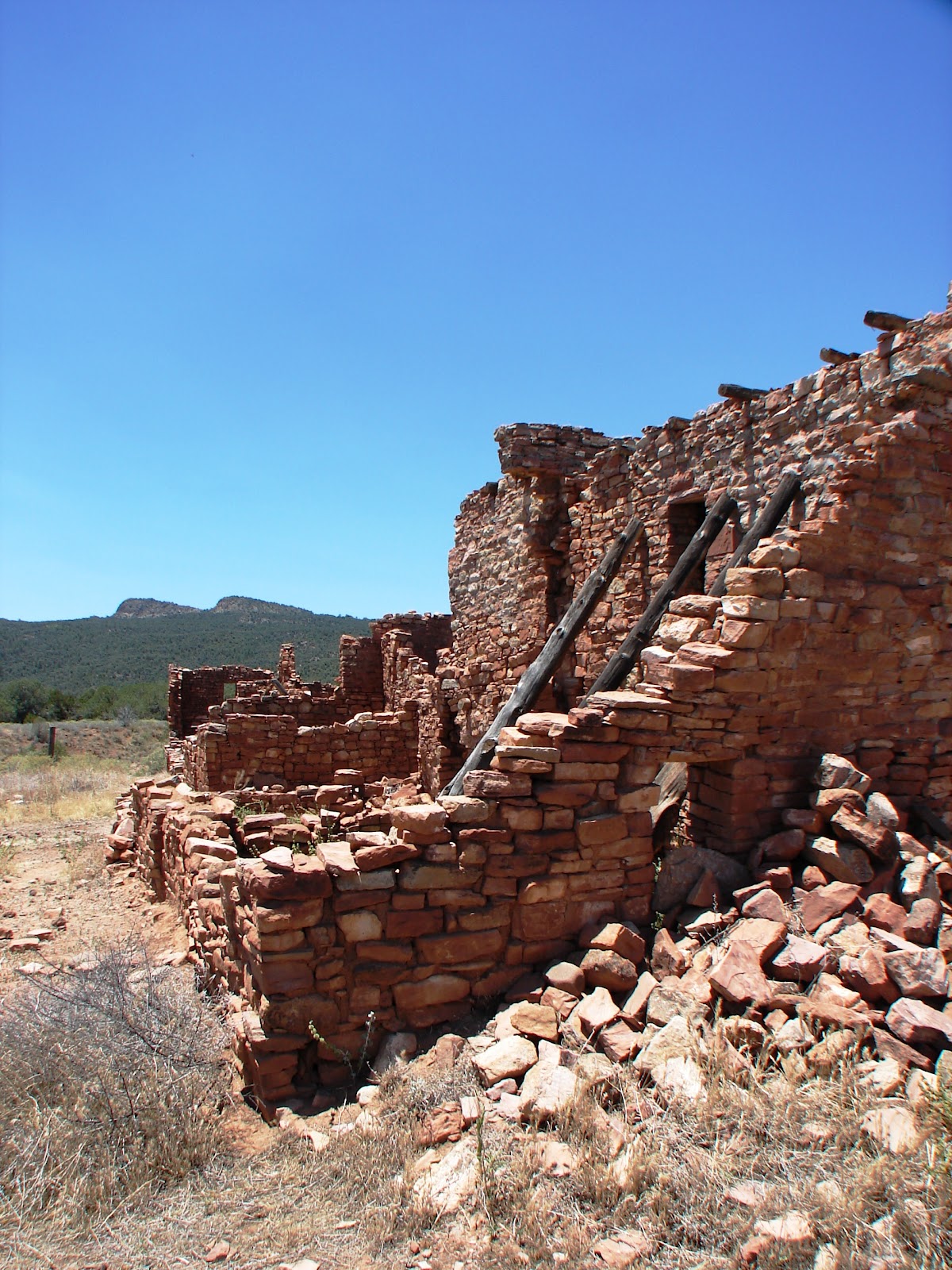
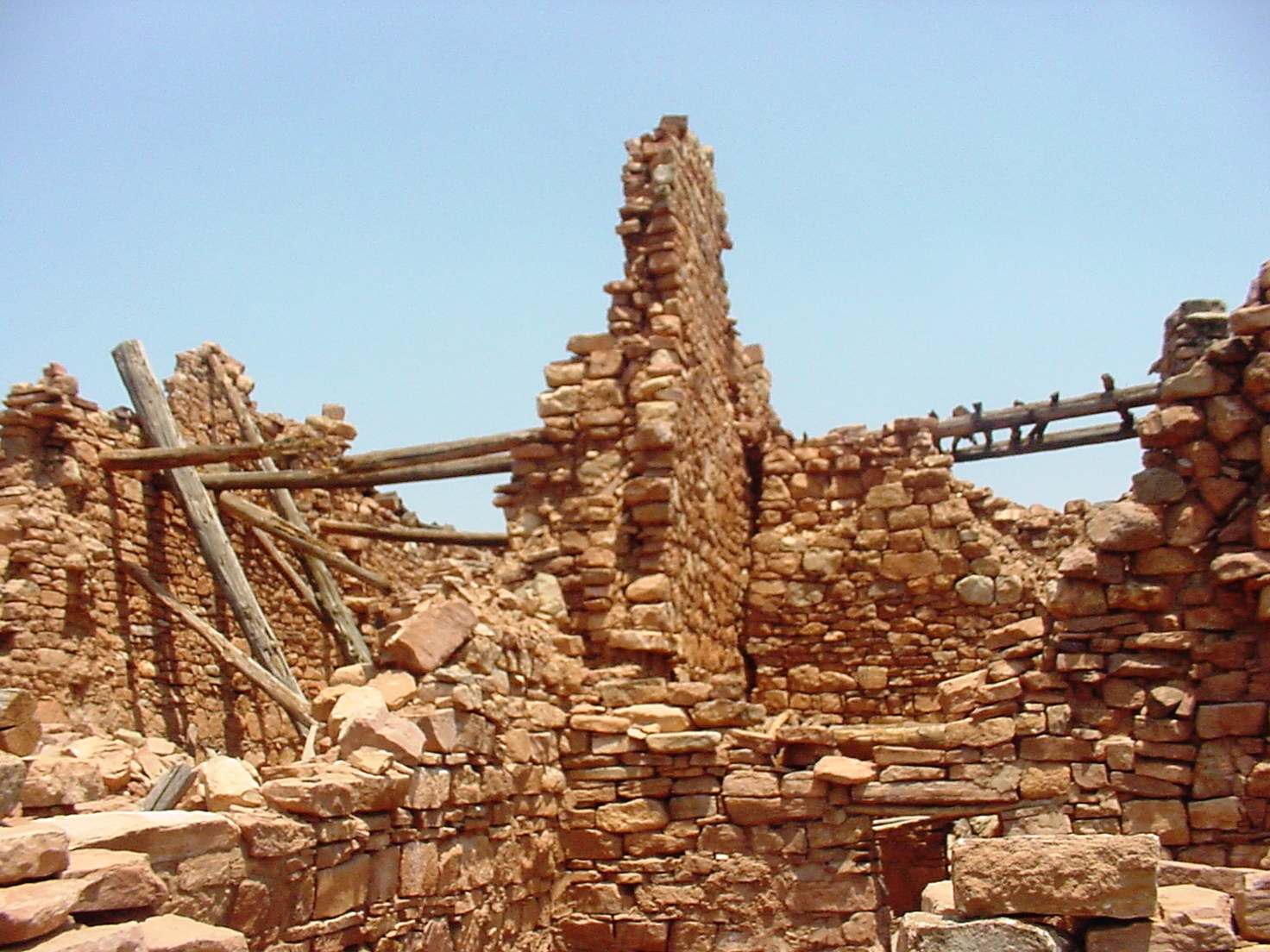
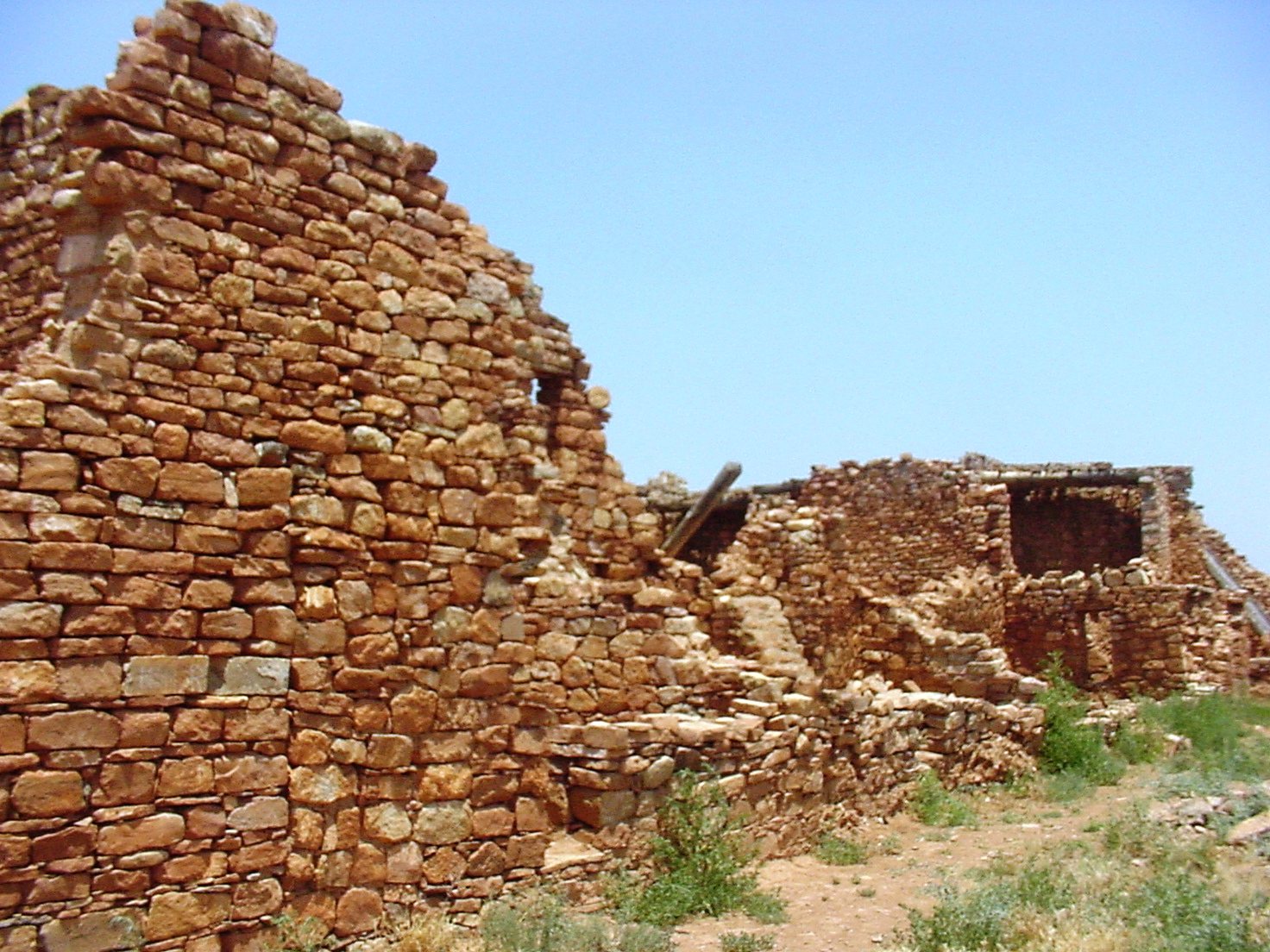
     A short five miles from Fort Apache on the White Mountain Apache Indian Reservation near Whiteriver, Arizona stands the ruins of the ancient pueblo known as Kinishba.  Kinishba receives its name from the Apache words “ki datbaa” which translate to mean “Brown House”.  It is the ruins of a pre-Columbian Pueblo village that was occupied by the Mogollon People around 1250 to 1400 A.D.
     The pueblo is located along a small arroyo at the far end of grass covered valley.  It was a large pueblo, with 400 – 500 ground level rooms rising to two and three stories in height. At its apex, archeologist believe as many as 1000 Mogollon People occupied this beautiful White Mountain site.
Kinishba is the most publicly accessible of the 20+ large Mogollon Pueblo village ruins found in this part of Arizona.  It was built as a part of the large Mogollon Rim colonization that occurred during this period of time. 
     Kinishba is located at an elevation of about 5000 feet, south of the Mogollon Rim, north of the Salt River and at the far eastern end of the Sawtooth Mountains.  Here the people found land ideal for dry maize farming, a year-round source of water, and abundant sources of sandstone, limestone and ponderosa pine for pueblo construction.
     The Mogollon People, like all things named Mogollon, are named after Juan Ignacio Mogollon, Spanish Governor of New Mexico from 1712 – 1715, were the third of the three major cultures that occupied the land that would become Arizona from 300 B.C. – 1450 A.D.  In their heavily forested mountain highlands they created a culture based on dry, terrace farming, hunting and gathering. 
     It was the Mogollon People who first built the holy, underground chamber known as the kiva.  They would share their concept of the kiva with the ancient Anasazi and thus it was passed on to the modern Hopi, Zuni and other Pueblo People of the Little Colorado and Rio Grande Rivers.  It was from the sipapu of the Great Kiva that modern Pueblo People believe they emerged into this, the Fourth World.
     A visitor to Kinishba today can peer into the ancient rooms that once held the community store of ancient corn and the living space of generations of Mogollon families.  The village is made up of eight major mounds, rectangular in shape with large courtyards or plazas mixed among them.
The first major restoration of Kinishba occurred in the 1930s yet much work still needs to be done.  It is one of too many historic places in Arizona waiting for appropriate funds to restore and preserve their story. 
     Archeological evidence from the Kinishba site indicate that both the Hopi and Zuni people occupied the ruins possibly as late as the early 19th Century.  Archeologist in 1989 even went so far as to suggest that Kinishba just might be the fabled Chiciticale, made famous by the historic visit of Francisco Vasques de Coronado in May of 1540.  
     Permission to visit Kinishba ruins must be obtained from the Visitor Center located at Fort Apache.  The entry fee for Fort Apache also allows one to visit the Brown House of the White Mountains – Kinishba!


Monday, September 3, 2012

Amazing Arizona Ruins - Begin at Honanki

         Arizona's Native American and U.S. military ruins are spectacular.  Yet some of these ruins are not part of the National or State Park systems.  Here is the first of 4 stories about these ruins dealing with an amazing ruin called Honanki.  If you are looking for a great autumn outing, let us suggest you discover Honanki.

The Sinagua Indians of the Verde Valley left many prehistoric ruins for Arizonans to visit today.  The Sinagua, the name given to these Native American people by the Spanish Conquistadors and which means “without water”, were the dominate culture in the Verde Valley between 500 - 1300 A.D.
    Some of the Sinagua ruins, like Montezuma Castle and Tuzigoot, are U.S. National Monuments with thousands of tourists visiting each year.  But there are lesser-known Sinagua sites to visit that are not national monuments but equally spectacular.  One such site is called Honanki.
     The Sinagua are believed to be ancestors of the Hopi people.  Honanki is a Hopi word that means “bear house.”  The Honanki ruins are some of the largest Sinagua ruins in the Verde Valley with over 30 ground floor rooms located under a cliff.  Parts of the ruins were once two to three stories in height.
    The architecture of Honanki is impressive but the petroglyphs and pictographs found there are quite special.  The ancient flute-player, Kokopelli, stands watch over the site. Glyphs of ancient hands remind today’s visitors of those who have gone before.  Spirit and animal petroglyphs are found throughout the site.
    Evidence found at Honanki indicated that the site was also used by the modern Yavapai Apache people.  The name Yavapai means “people of the sun.”  A second ruins close to Honanki, called Palatki (meaning “red house”) indicates similar cultural use.
    The Archeological Resource Protection Act of 1979 protects all historic sites of Arizona, including Honanki.  Any disturbance of a historical site or collection of artifacts is against the law.  Take only pictures and leave only footsteps are the laws for all of Arizona’s historical sites.
    Honanki is located between the towns of Cottonwood and Sedona.  Visitors to Honanki should travel north from Cottonwood, on Highway 89A toward Sedona. About 1/2 mile beyond mile-marker 364, turn left onto Forest Road 525, the Loy Butte Road.  Follow the signs on a good dirt road for 10.2 miles to the parking area for Honanki.
    A one-day, $5.00 Red Rock Pass is required to visit Honanki.  For more information about where to buy a Red Rock Pass, visit the following web site: http://www.redrockcountry.org/.


The GPS coordinates for the parking lot of Honanki is N 34 56.190’ W 111 56.060’.  An easy 1/8-mile hiking trail leads to the ruins.  For more information about Honanki, visit the following web site: http://www.fs.fed.us/r3/coconino/recreation/red_rock/honanki-ruins.shtml


A real Kokopelli pictograph.


Pictographs of ancient hands.


Tuesday, August 28, 2012

Arizona - The Name

     We have often been asked over the years, just how did Arizona get its name.  This story is our best answer and the one we now think is correct.

      For well over 100 years historians have searched and argued over the genesis of the name, Arizona.  In the mid-1940s a consensus was reached that the name, Arizona, probably came from two words from the Akimel O'odham People (the River People and more commonly known as the Pima) language, Ali-Shonak that translated to mean “place of the small spring.”  In fact we taught this meaning, "Place of the Small Spring" to our students for years.
     Yet through the years others have suggested that Arizona comes from the Mexica (Ma-she-ka or Aztec) word “arizuma” meaning “silver-bearing” or some word from some language meaning, “arid-zone.”  The debate has raged on for years. Now and as a result of years of hard work, travel and research by one Arizona National Park Ranger there just may be an agreement as to the true origin of the name, Arizona.
    For the past 25 years National Park Ranger, Don Garate', of Tumacacori National Monument has been researching Spanish historical records to determine where and when the word, Arizona, first appeared in official Spanish documents.  His efforts have resulted in a new idea, rooted in historical facts, as to the origin of our state’s wonderful name.
    It seems that in 1736 at a place some 40 miles south of Tumacacori National Monument and about 10 miles below today’s international border, boulders of silver were discovered on a ranch owned by a Basque rancher, Bernardo de Urrea.  The silver strike was officially recorded as Planchas de Plata and one boulder was recorded to weigh up to 2500 pounds.  All together over 4,000 pounds of silver were recovered from this strike.
     The land and canyons that encompassed Urrea’s ranch were covered with oak trees and thus he was calling the area of his ranch “Aritzonac.” In the Basque language “aritz’ means oak and “on” translates to good and “a” means the – “the good oak” tree.  Add a “c” to make it plural, Aritzonac, and now it means “the good oak trees.”  It is an easy transition from Aritzona to Arizona.
     We believe that Ranger Garate’s research has now put an end to the years and years of debate as to how the name Arizona came into use.  If you are interested in reading more about Ranger Don Garate's work, check out this link - www.nps.gov/tuma/historyculture/arizona-planchas-de-plata.htm 


Over the years, five flags have flown over Arizona - the flag of King Carlos III, the Castilian Flag, the flag of Mexico, the flag of the Confederate States of America and Old Glory, flag of the United States of America.
 

Monday, August 20, 2012

The Motor Lodge - Prescott, Arizona

     It is always good to travel to Prescott, Arizona.  The mile-high, one-time capitol of Arizona is loaded with historic venues, beautiful natural escapes and just a wonderful places to kick-back and spend a cool evening in the pines.  This is our third special piece of Americana still found in Arizona.  Please note that all the photos at the end of this story belong to The Motor Lodge.


     The Motor Lodge in Prescott is another of those jewels in Arizona’s “Crown of Classic Americana” that are found scattered around and in our state’s small cities and towns.  Similar to the Wigwam Motel in Holbrook and the Shady Dell in Bisbee, The Motor Lodge is another of those fun and enjoyable places to stay for all who still get a kick out of going back in time to a more carefree and happy of days.
     Like so many of the unique historic properties found around Arizona, The Motor Lodge owes its current survival and retro charm to the dreams and the hard work of business partners Brian Spear and Joe Livingston who bought the lodge in April 2008.  They discovered that the 12 rooms of their newly acquired adventure seemed to be “stuck in time” and quickly realized that with a little fixing-up, they just might have acquired a very special piece of Americana. 
     In the bottom drawer of an old office filing cabinet they discovered a letter that indicated that the lodge had originally been built as summer cabins around 1910.  Over the years it passed from one owner to another with a variety of names and refurbishments.
     During the 1940s the cabins rooflines were connected giving today’s lodge a distinctive horseshoe court appearance.  Today’s guests are treated to a boutique-style hotel with each room uniquely decorated with an eclectic assortment of furniture and art.  The lodge’s neon sign still beckons travelers to come and relax while sitting on one of the cabins’ front porches, just watching time go by.
     All modern amenities are included as well as a romantic tandem bicycle that can be borrowed for the short, 3-block ride to the historic Prescott square.  Charm and personalized service are the trademarks of this Arizona motor inn.
     In 2010 the “People’s Choice” awards from TripAdvisor.com declared The Motor Lodge the  #3 hotel out of 53,000 America hotels for service and the #5 hotel for bargain pricing. Arizona Highways magazine declared the lodge as one of the top five places to stay in 2009 and Travel.azcentral.com recently voted the lodge the top bargain hotel in all the state.
     So as the days of summer continue and you look for an escape to a cooler place, keep in mind The Motor Lodge in Prescott.  You will enjoy unmatched hospitality, charm and new memories of a nostalgic time still found in Arizona. 


     Here is a link to this wonderful and fun place to stay - http://themotorlodge.com/