Tovrea Castle is one of the great landmarks of Phoenix. The three-tiered wedding cake-shaped home has intrigued generations of Phoenicians. The City of Phoenix now owns both Tovrea Castle and the surrounding Carraro Cactus Garden.
Italian immigrant Alessio Carraro and his 15-year old son, O. Leo, began building their unique castle in 1929. He intended it to be a centerpiece hotel for an upscale housing development to be called Carraro Heights.
Working with plans drawn only in the dirt with a stick, the three-tiered, elongated octagon wood frame covered with stucco slowly rose from the 227-acre cactus covered site. A multi-windowed cupola crowned Mr. Carraro’s castle giving he and his visitors a spectacular view of the Salt River Valley. Russian gardener, M. Moktatchev was hired by Mr. Carraro to create the Valley’s best cactus garden to surround his castle hotel.
In 1931 hard times fell upon Mr. Carraro and he had to sell his beloved castle. Cattleman E.A. Tovrea and his wife, Della, purchased the castle as their private residence. Mr. Tovrea operated a beef slaughter and packinghouse near their new castle home. They renamed their new home Tovrea Castle.
Mr. Tovrea and Della immediately constructed a stonewall to surround the 43 acres of their castle home and cactus garden. E. A. Tovrea would die in 1932 but Della lived in the castle until her death in 1969.
In 1970 the Tovrea Family Trust assumed control over the castle and the surrounding garden. For the next 30 years the castle remained largely unused and poorly maintained. Finally in 1993 the City of Phoenix purchased the historic Tovrea Castle and 7 1/2 acres of the cactus garden surrounding the home. In 2003, Phoenix purchased the additional 36 acres of land, finally taking control of all 43 acres of Tovrea Castle and Carraro Cactus Garden.
For more information about visiting the Carraro Cactus Garden and Tovrea Castle, visit the following web site: http://www.tovreacastletours.com/.
Tovrea Castle and Carraro Cactus Garden are located at 5041 East Van Buren, Phoenix, Arizona.
For anyone wanting to learn about Arizona and the many amazing historic and natural places to visit and enjoy - this is a blog designed for you.
Monday, April 14, 2014
Friday, April 11, 2014
How About A Historic Steak At The Stockyards?
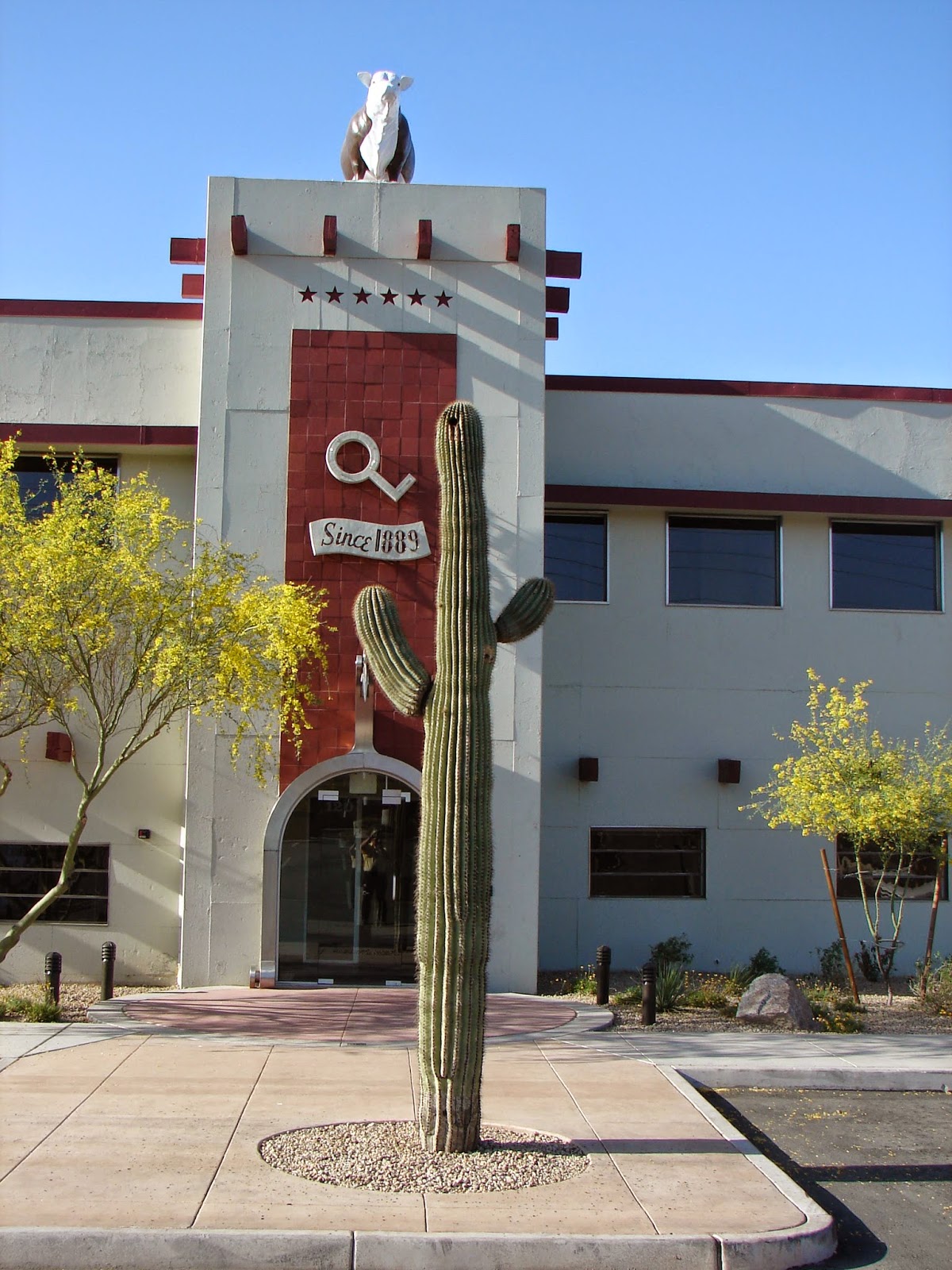
There was no greater “Cattle Baron” in the Phoenix area than Edward A. Tovrea. Modern Arizonans can touch his legacy not only at the beloved Tovrea Castle but also at the historic Stockyards Restaurant and 1889 Saloon. Cattle were one of the original 5Cs from which the economy of the new State of Arizona would grow after February 14, 1912.
In 1919 Ed Tovrea rode into the small town of Phoenix and began a packinghouse near 48th Street and Van Buren to support his growing beef operations. At this site, by the early 1950s, the Tovrea Land & Cattle Company owned 200 acres of cattle pens, holding at times over 40,000 head of cattle. It was the largest cattle feedlot in the world.
When a new administrative building was built in 1947 for the cattle company, it included Arizona’s original steakhouse, The Stockyards Restaurant. It soon became the favorite eating spot for cattlemen, bankers and politicians of Arizona. Historic lore tells that John Wayne once ate here and for certain did Arizona great Barry Goldwater.
The old restaurant was renovated in 2005 and when it reopened it kept its Old West charm and famous steaks. The historic building is now on the City of Phoenix Historic Register for its unique architectural style.
The Stockyards has three dining rooms: the Cattleman’s Room, the Gold Coast Room and the Rose Room, with vintage rose-colored booths. The walls are adorned with murals painted in 1954 and antique lighting fixtures hang throughout the building.
The 5Cs of Arizona theme is carried out with Cattle (beef) and Citrus being served, a huge Copper door that is highly polished to reflect the sunshine of Arizona’s wonderful Climate, and many a modern cowboy enters wearing a shirt made of Cotton.
The 1889 Saloon has a massive hand-carved cherry, mahogany bar with an 1887 player piano. It represents both the Gay 1890s and the rich cattle baron lifestyle of Edward A. Tovrea. Original murals by artists Katherine Patton decorate the walls of the 1889 Saloon as well as the walls of the Rose Room.
So when you get out and are looking for the best steaks in Phoenix, remember The Stockyards Restaurant and 1889 Saloon. Great food and great Arizona history all found under one roof!
The Stockyards Restaurant is located at 5009 East Washington Street, Phoenix, Arizona. For more information about The Stockyards Restaurant and 1889 Saloon visit their web site: http://www.stockyardsrestaurant.com/.
In 1919 Ed Tovrea rode into the small town of Phoenix and began a packinghouse near 48th Street and Van Buren to support his growing beef operations. At this site, by the early 1950s, the Tovrea Land & Cattle Company owned 200 acres of cattle pens, holding at times over 40,000 head of cattle. It was the largest cattle feedlot in the world.
When a new administrative building was built in 1947 for the cattle company, it included Arizona’s original steakhouse, The Stockyards Restaurant. It soon became the favorite eating spot for cattlemen, bankers and politicians of Arizona. Historic lore tells that John Wayne once ate here and for certain did Arizona great Barry Goldwater.
The old restaurant was renovated in 2005 and when it reopened it kept its Old West charm and famous steaks. The historic building is now on the City of Phoenix Historic Register for its unique architectural style.
The Stockyards has three dining rooms: the Cattleman’s Room, the Gold Coast Room and the Rose Room, with vintage rose-colored booths. The walls are adorned with murals painted in 1954 and antique lighting fixtures hang throughout the building.
The 5Cs of Arizona theme is carried out with Cattle (beef) and Citrus being served, a huge Copper door that is highly polished to reflect the sunshine of Arizona’s wonderful Climate, and many a modern cowboy enters wearing a shirt made of Cotton.
The 1889 Saloon has a massive hand-carved cherry, mahogany bar with an 1887 player piano. It represents both the Gay 1890s and the rich cattle baron lifestyle of Edward A. Tovrea. Original murals by artists Katherine Patton decorate the walls of the 1889 Saloon as well as the walls of the Rose Room.
So when you get out and are looking for the best steaks in Phoenix, remember The Stockyards Restaurant and 1889 Saloon. Great food and great Arizona history all found under one roof!
The Stockyards Restaurant is located at 5009 East Washington Street, Phoenix, Arizona. For more information about The Stockyards Restaurant and 1889 Saloon visit their web site: http://www.stockyardsrestaurant.com/.
Thursday, April 10, 2014
Deer Valley Rock Art Center
Many residents of Anthem might find it hard to believe that just 10 miles south of their community an ancient volcanic lava flow broke through the earth’s surface some 1.6 million years ago. It flowed along the surface of the land for over 1/4 mile before cooling and creating a small mountain of volcanic basalt rock.
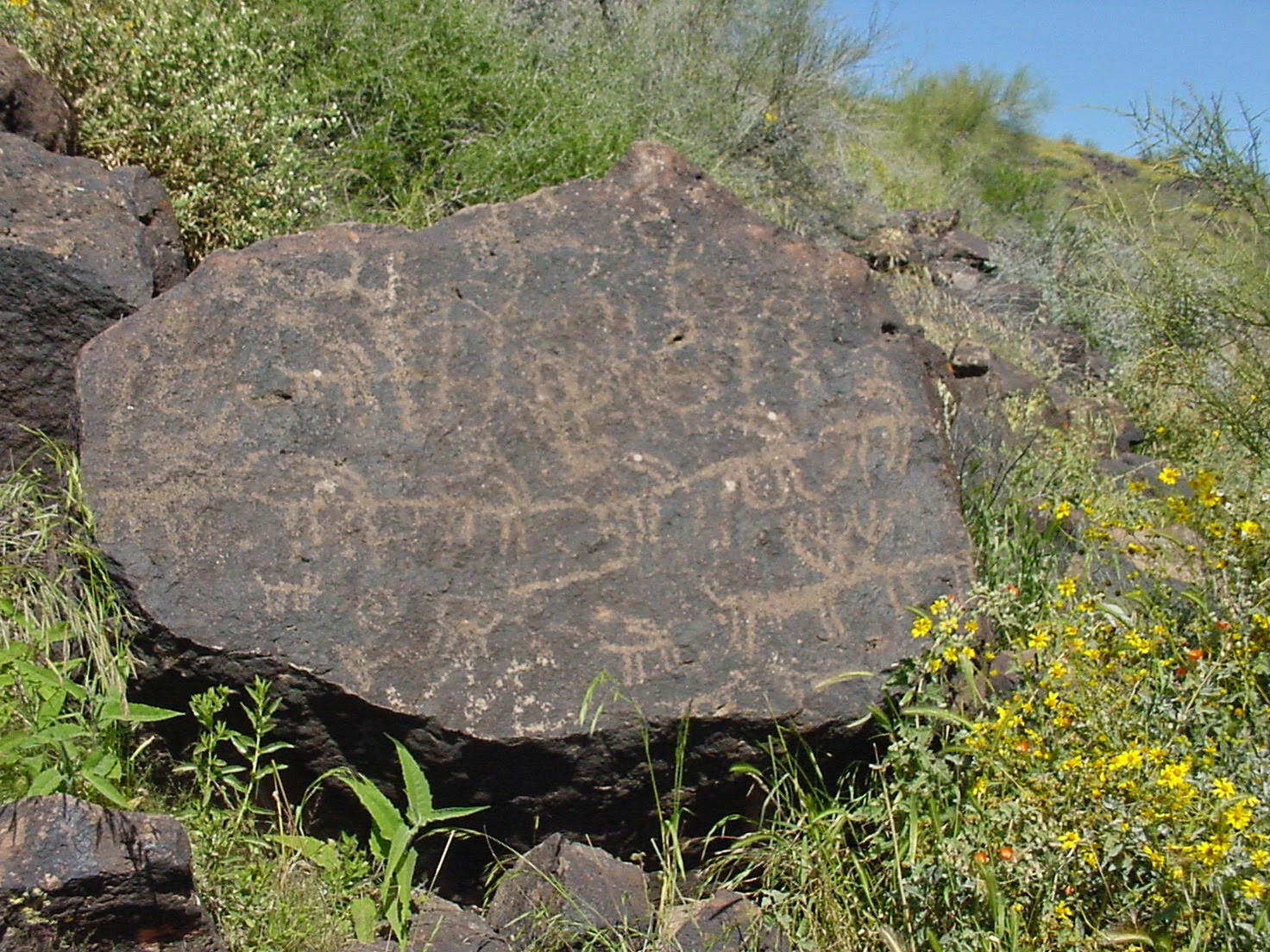
Over the ages this lava flow has weathered into a mountain of a thousand boulders. Upon these boulders can now be found over 1500 ancient petroglyphs made by people who once made this special place their home. This mountain today is called Hedgpeth Hill and is the major attraction of the Deer Valley Rock Art Center.
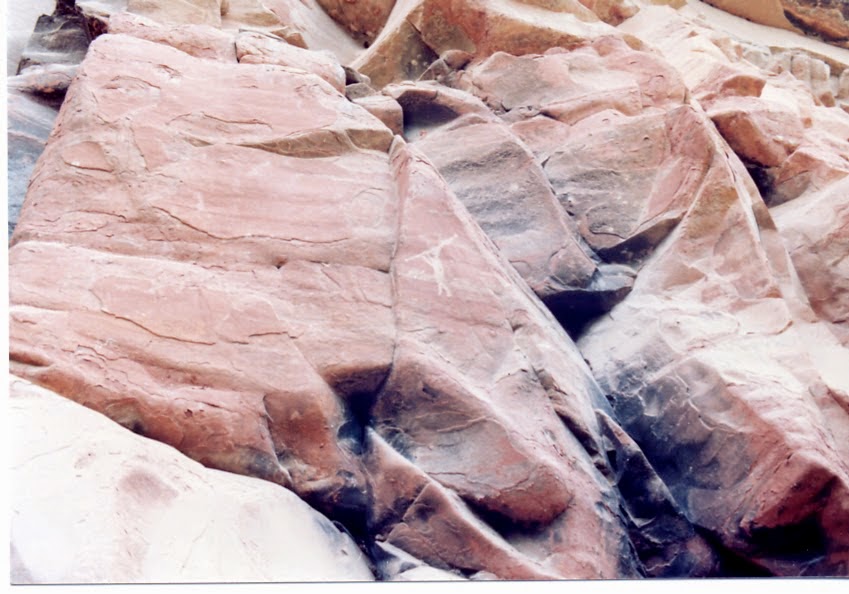
It was sometime after 300 B.C. that the Hohokam and Patayan people climbed over and among this boulder covered mountain that ran along the side of a small desert stream. Using their stone tools they pecked into the desert varnish that had formed upon the boulders, leaving their pictures and designs for us to learn from and enjoy today.
The Deer Valley Rock Art Center has the largest concentration of ancient rock art found in the Valley of the Sun. Here, along the western bank of what is today called Skunk Creek, ancient people left their carvings of deer, big-horned sheep, running water and various clan symbols.
One ancient human even left a carving of a right hand as it grabbed the edge of a volcanic boulder. Many of the man-made petroglyphs may be symbols representing an ancient spirituality. Anthropologists believe that some of these glyphs may be as much as 5000 years old.
The genesis of the rock art center can be found in the tremendous flooding that occurred across the Valley in the late 1970s and early 1980s. Wishing to prevent further flooding of the city, the U.S. Corp of Engineers decided to build large earthen dams across the northern parts of Phoenix.
One such dam, known as the Adobe Dam, was built near 35th Avenue and Deer Valley Road to control any future flooding of Skunk Creek. The petroglyphs on the ancient volcanic basalt mountain were deemed to be a historic treasure and plans were made to protect and preserve them.
Through an agreement between Maricopa County, the City of Phoenix, the U.S. Corp of Engineers and the School of Human Evolution & Social Change of Arizona State University, the Deer Valley Rock Art Center opened to the citizens of Arizona in 1994. Today it is listed on the National Register of Historic Places.
The Deer Valley Rock Art Center takes its name from a large boulder covered with multiple petroglyphs, including one of two nose-to-nose facing deer. In 2000 the City of Phoenix designated the Deer Valley Rock Art Center as a Phoenix “Point of Pride”. Self guided and guided tours for individuals, school and adult groups are available by the family friendly and knowledgeable staff.
The Deer Valley Rock Art Center is located at 3711 West Deer Valley Road. For more information about the DVRAC visit their web site at http://www.asu.edu/clas/shesc/dvrac/ .
Over the ages this lava flow has weathered into a mountain of a thousand boulders. Upon these boulders can now be found over 1500 ancient petroglyphs made by people who once made this special place their home. This mountain today is called Hedgpeth Hill and is the major attraction of the Deer Valley Rock Art Center.
It was sometime after 300 B.C. that the Hohokam and Patayan people climbed over and among this boulder covered mountain that ran along the side of a small desert stream. Using their stone tools they pecked into the desert varnish that had formed upon the boulders, leaving their pictures and designs for us to learn from and enjoy today.
The Deer Valley Rock Art Center has the largest concentration of ancient rock art found in the Valley of the Sun. Here, along the western bank of what is today called Skunk Creek, ancient people left their carvings of deer, big-horned sheep, running water and various clan symbols.
One ancient human even left a carving of a right hand as it grabbed the edge of a volcanic boulder. Many of the man-made petroglyphs may be symbols representing an ancient spirituality. Anthropologists believe that some of these glyphs may be as much as 5000 years old.
The genesis of the rock art center can be found in the tremendous flooding that occurred across the Valley in the late 1970s and early 1980s. Wishing to prevent further flooding of the city, the U.S. Corp of Engineers decided to build large earthen dams across the northern parts of Phoenix.
One such dam, known as the Adobe Dam, was built near 35th Avenue and Deer Valley Road to control any future flooding of Skunk Creek. The petroglyphs on the ancient volcanic basalt mountain were deemed to be a historic treasure and plans were made to protect and preserve them.
Through an agreement between Maricopa County, the City of Phoenix, the U.S. Corp of Engineers and the School of Human Evolution & Social Change of Arizona State University, the Deer Valley Rock Art Center opened to the citizens of Arizona in 1994. Today it is listed on the National Register of Historic Places.
The Deer Valley Rock Art Center takes its name from a large boulder covered with multiple petroglyphs, including one of two nose-to-nose facing deer. In 2000 the City of Phoenix designated the Deer Valley Rock Art Center as a Phoenix “Point of Pride”. Self guided and guided tours for individuals, school and adult groups are available by the family friendly and knowledgeable staff.
The Deer Valley Rock Art Center is located at 3711 West Deer Valley Road. For more information about the DVRAC visit their web site at http://www.asu.edu/clas/shesc/dvrac/ .
Friday, April 4, 2014
Kitt Peak - the "Long Eyes" of Arizona's Sky
Astronomy is a major scientific industry of Arizona. Eleven astronomical observatories are found in the small towns and high mountain tops scattered across Arizona. One of the most fascinating and enjoyable observatories to visit is Kitt Peak National Observatory located just 56 miles southwest of Tucson.
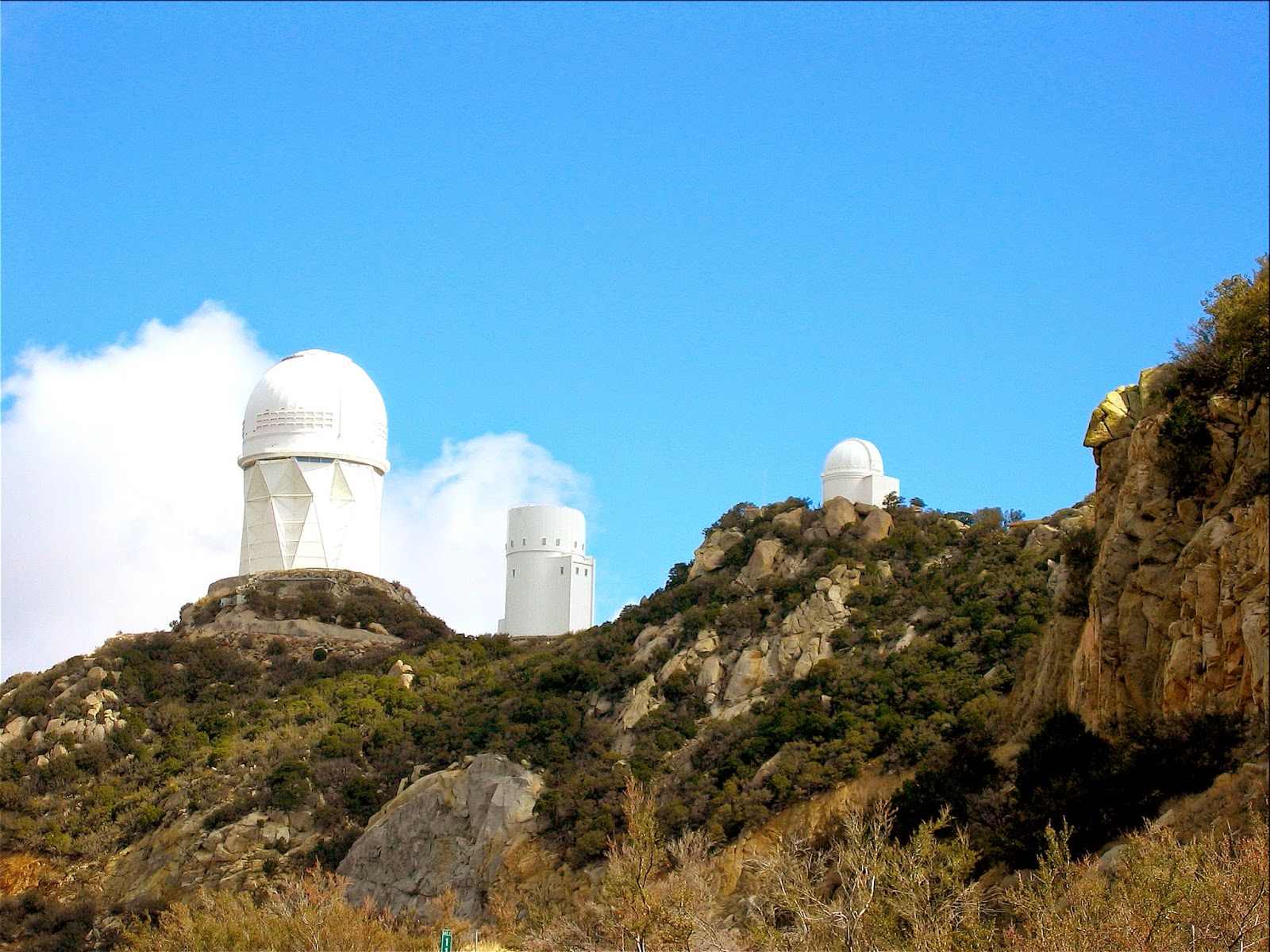
Kitt Peak National Observatory is a part of the National Optical Astronomy Observatory (NOAO) system. Here on the 6875 foot high mountain top located on the Tohono O’odham Reservation, is found the world’s largest and most diverse observatory with an amazing collection of nightime optical and infrared telescopes as well as the world’s largest solar telescope.
Twenty-four optical and two radio telescopes turn their scientific light-sensitive eyes toward the heavens found above the clear, dry Sonoran Desert sky. These delicate scientific “Long-eyes”, as they were called by the native people, are use by eight different astronomical research institutions under the National Science Foundation to search for the answers to the celestial universe.
It was after the launch of Sputnik in 1957 that American astronomers petitioned the federal government to build a national observatory to coordinate their heavenly research. Over 100 mountains in the western portion of the United States were considered as possible sites. Arizona’s own Kitt Peak was determined to be the most advantageous.
Astronomers cherished the high percentage of cloudless nights above Kitt Peak. In addition the atmosphere above Kitt Peak was found to be “remarkably steady” that provided the telescopes of Kitt Peak to have many nights of “excellent seeing!”
The high elevation and location is the middle of the Sonoran Desert meant that Kitt Peak most often was surrounded by an atmosphere with low levels of relative humidity which meant the delicate mirrors of the telescopes would remain clear of moisture.
Finally, the University of Arizona had a strong astronomy program that could provide the observatory with trained personnel and the small size of Tucson (1958) meant very little light pollution would reach the mountain top.
Construction of Kitt Peak National Observatory began May 5, 1958 with the facility’s dedication occurring on March 15, 1960. The array of telescopes open to the pubic to visit makes this Arizona mountain top an astronomer's Disneyland.
The McMath-Pierce Solar Telescope is the world’s largest solar instrument with a part of the telescope continuing into the mountain. The study of the structure of solar sunspots is a major focus of this instruments research.
The eighteen story Mayall Telescope can be seen from over fifty miles away. The dome of this instrument weighs 500 tons and the 15-ton primary mirror is polished to one millionth of an inch with a reflective aluminum coating one thousandth the thickness of a human hair.
Kitt Peak also made astronomical history when in 1980 its 91-centimeter reflector telescope became the first in the world assigned to seek and track near-earth asteroids. The “Spacewatch Project” continues each night to seek objects that might create a hazard for space flight and for the earth.
The “Long Eyes of Kitt Peak” are open to visitors every day of the year except Thanksgiving, Christmas and New Years. Arrangements can be made for visitors to join astronomers atop Kitt Peak and view the wonders of the nighttime sky. For anyone interested in the nightime sky, Kitt Peak is the crown jewel in America’s astronomical program.
Link - https://www.noao.edu/kpno/
Photos 1 - 7 were taken by our friend Ken Jackway at www.photoarizona.com; the remaining pictures are public domain photos and are courtesy of National Optical Astronomy Observatory
Kitt Peak National Observatory is a part of the National Optical Astronomy Observatory (NOAO) system. Here on the 6875 foot high mountain top located on the Tohono O’odham Reservation, is found the world’s largest and most diverse observatory with an amazing collection of nightime optical and infrared telescopes as well as the world’s largest solar telescope.
Twenty-four optical and two radio telescopes turn their scientific light-sensitive eyes toward the heavens found above the clear, dry Sonoran Desert sky. These delicate scientific “Long-eyes”, as they were called by the native people, are use by eight different astronomical research institutions under the National Science Foundation to search for the answers to the celestial universe.
It was after the launch of Sputnik in 1957 that American astronomers petitioned the federal government to build a national observatory to coordinate their heavenly research. Over 100 mountains in the western portion of the United States were considered as possible sites. Arizona’s own Kitt Peak was determined to be the most advantageous.
Astronomers cherished the high percentage of cloudless nights above Kitt Peak. In addition the atmosphere above Kitt Peak was found to be “remarkably steady” that provided the telescopes of Kitt Peak to have many nights of “excellent seeing!”
The high elevation and location is the middle of the Sonoran Desert meant that Kitt Peak most often was surrounded by an atmosphere with low levels of relative humidity which meant the delicate mirrors of the telescopes would remain clear of moisture.
Finally, the University of Arizona had a strong astronomy program that could provide the observatory with trained personnel and the small size of Tucson (1958) meant very little light pollution would reach the mountain top.
Construction of Kitt Peak National Observatory began May 5, 1958 with the facility’s dedication occurring on March 15, 1960. The array of telescopes open to the pubic to visit makes this Arizona mountain top an astronomer's Disneyland.
The McMath-Pierce Solar Telescope is the world’s largest solar instrument with a part of the telescope continuing into the mountain. The study of the structure of solar sunspots is a major focus of this instruments research.
The eighteen story Mayall Telescope can be seen from over fifty miles away. The dome of this instrument weighs 500 tons and the 15-ton primary mirror is polished to one millionth of an inch with a reflective aluminum coating one thousandth the thickness of a human hair.
Kitt Peak also made astronomical history when in 1980 its 91-centimeter reflector telescope became the first in the world assigned to seek and track near-earth asteroids. The “Spacewatch Project” continues each night to seek objects that might create a hazard for space flight and for the earth.
The “Long Eyes of Kitt Peak” are open to visitors every day of the year except Thanksgiving, Christmas and New Years. Arrangements can be made for visitors to join astronomers atop Kitt Peak and view the wonders of the nighttime sky. For anyone interested in the nightime sky, Kitt Peak is the crown jewel in America’s astronomical program.
Link - https://www.noao.edu/kpno/
Photos 1 - 7 were taken by our friend Ken Jackway at www.photoarizona.com; the remaining pictures are public domain photos and are courtesy of National Optical Astronomy Observatory
Thursday, April 3, 2014
Canyon de Chelly National Monument
The word “spectacular” is probably too often used when writing or speaking about the natural wonders of Arizona, but spectacular is surely the most appropriate adjective when referring to Canyon de Chelly (da shay). Located in the northeast corner of Arizona on the Navajo Nation, Canyon de Chelly is a “must see” sight for every Arizonan.
Canyon de Chelly National Monument was created in 1931 and is unique in the National Park system as the land is entirely Navajo Tribal Trust Land. The monuments spreads over 131 square miles and is an outdoor museum of artifacts from the indigenous people, known as the Anasazi, who once made the canyon their home.
There are over 2700 archeological sites of petroglyphs and cliff dwellings within the national monument. Only 13 of the 700 standing ruins have been stabilized and open to visitors. Modern Navajo still farm the fertile valleys just as their ancestors have done for the past 700 years.
The national monument really encompasses four different canyons: de Chelly, de Muerto, Black Rock and Monument. Canyon walls up to 1000 foot high were cut by a series of major streams whose headwaters are located in the Chuska Mountains just east of the monument.
The name, Canyon de Chelly, comes from the Navajo word “Tsegi” which means “among the rocks” or “rock canyon.” The rock walls vary from red granites and quartzites to sandstone and conglomerates. The national monument is truly a geological treasure and natural textbook.
Canyon de Chelly was also the site of many tragic encounters between the Navajo people and the Spanish conquistadors as well as the United States Army. It was here in 1863 that Kit Carson led U.S. cavalry into Canyon de Chelly resulting in the 1864 Navajo Long Walk to Fort Sumner, New Mexico.
Visitors to Canyon de Chelly National Monument can travel on two rim roads to view into the monument. The South Rim Drive is 37 miles round trip and allow the visitor to look down upon the 800 foot high Spider Rock and the White House Ruin. The North Rim Drive is 34 miles round trip and offers views of Lodge Ruin, Mummy Cave Ruin and the famous Antelope Ruin. Both rim drives are free and open to the public and well worth the time and effort.
To enter the canyon or to visit anywhere else in Canyon de Chelly National Monument requires a park ranger or Navajo guide. You may drive your own four-wheel drive vehicle with a guide or reserve a tour through the many jeep/truck tour companies.
Canyon de Chelly National Monument is located just east of Chinle, Arizona. Visitors might choose to stay at the historic Thunderbird Lodge or the Chinle Holiday Inn. Both hotels offer canyon tours. Horseback tours into the canyon are also available.
Canyon de Chelly can be very hot in the middle of the summer so springtime is an ideal time to visit. When you go, you will have visited yet another of the many spectacular places found in our Arizona!
Link - http://www.nps.gov/cach/index.htm
| A real Kokopelli |
| Spider Rock |
| More petroglyphs |
| White House Ruins |
| Rain in Canyon de Chelly |
| White House Ruins from the rim road |
| White House Ruins once again |
Subscribe to:
Comments (Atom)